

SIGMA GEO offers electrical exploration survey using the 2D TEM method to solve oil and gas exploration problems (research depth up to 4-6 kilometers).
About technology
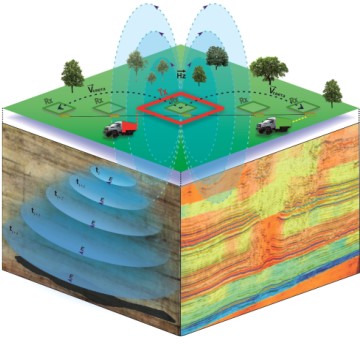
2D TEM is a profile modification of a transient electromagnetic method (TEM) in the near-field zone - a pulse-controlled source method based on the study of a transient processes which is excited when the current in the source changes.
2D TEM soundings are carried out at the regional and prospecting and assessment stages of geological exploration.
Geological objectives by the 2D TEM method |
|
 |
|
 |
|
 |
|
 |
|
Methods of field work, equipment and facilities
Generally, the design of a 2D TEM observation network is carried out using a network of 2D CDPM seismic profiles; any roads available in the area are also taken into account: rural, forest, logging and others.
The parameters of the 2D TEM observation technique may vary depending on the characteristics of the experimental site and the geological tasks, however, most often five-spaced stations with square transmitter (500 x 500 or 600 x 600 m) and receiving (18 x 18 m, 29 turns) loops are used, and the current strength in the transmitter loop reaches 250 A.
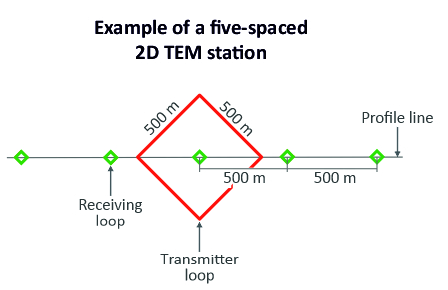
The use of coaxially-spaced stations makes it possible to identify effects such as induction-induced polarization and magnetic lag and take them into account at the interpretation stage.
When carrying out 2D TEM field work, digital telemetric electrical exploration stations SGS-TEM are used.
|
Measuring devices SGS-TEM |
Transistor current switch |
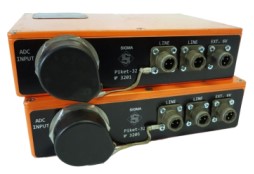
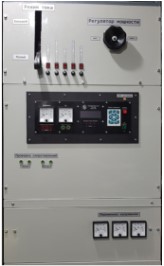
Optimal configuration of a fielded party:
 |
|
 |
|
 |
|
The average productivity of one fielded party per month is more than 450 physical points of the 2D TEM.
In-office studies
Electromagnetic data processing is carried out in the modern TEM-Processing program, which includes statistical and robust signal accumulation methods, as well as a set of specialized frequency filtering algorithms, including noise reduction of a high-line frequency 50 hz.
Quantitative interpretation of signals is performed in the Model software package, based on algorithms for solving forward and inverse problems developed at the Institute of Petroleum Geology and Geophysics SB RAS.
Quality control
 According to the requirements of the Electrical Prospecting Instructions, control observations are carried out without fail in the amount of 5% of the total number of planned observations. However, for additional control at both the field and in-office stages of work, quality assessment is performed using advanced software:
- EMQC - a comprehensive system for assessing data quality, which allows to automatically perform quality control of the material and quickly identify data complicated by electromagnetic interference, anomalous and substandard curves based on quantitative QC quality indicators.
- EMIQ - specialized software for assessing the quality of interpretation of sTEM and TEM materials.
The effect of using the 2D TEM technique
- Increased probability of geological success (in case of integration seismic and electrical prospecting using the TEM method)
- Reducing the risk of drilling non-productive wells.
SIGMA-GEO work experience using the 2D TEM method
- More than 22,000 lin km 2D TEM have been completed.
- More than 45,000 physical observations of 2D TEM.
- Work using the 2D TEM method has been tested in various climatic, geographical and geological conditions; the effectiveness of the predictions has been repeatedly confirmed by drilling.