Study of permafrost (permafrost)
SIGMA-GEO offers the use of transient electromagnetic method (TEM) in the near field zone in a shallow modification to solve the problem of mapping permafrost.
The relevance
Permafrost occupies a quarter of the world's land mass and is found on every continent except Australia. In Russia, the permafrost zone occupies 60-65% of the territory.
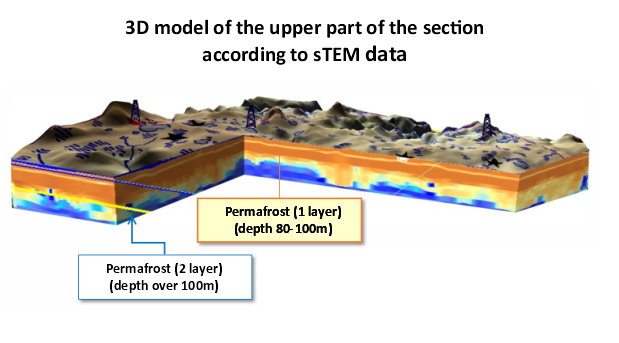 The main difficulties in carrying out geological exploration work in proveniance of permafrost are as follows:
- The upper part of the section has a strong influence on the traceability of boundaries from seismic data.
- The occurrence of characteristic problems during the drilling of wells (column collapse during thawing of wells, formation of ice plugs, gas breakthroughs during cementing).
- Cryogenic processes (soil heaving, thermokarst, etc.) constitute a danger to the infrastructure of deposits.
- The presence of gas in clathrate (gas hydrates) or free form in permafrost rocks leads to emissions during drilling.
Solutions
To solve the problems of mapping the distribution of permafrost, it is most effective to use the shallow modification of a transient electromagnetic method (TEM) in the near field zone due to the combination of the following factors:
- Permafrost rocks are localized in the upper part of the section.
- Permafrost rocks have increased electrical resistivity, especially against the background of of a highly conductive section (characteristic, for example, of Western Siberia).
- An additional factor indicating the presence of permafrost is the occurrence of inductively induced polarization in the sTEM curves.
Advantages of the sTEM method in permafrost mapping
- sTEM stations do not require galvanic grounding. For this reason, research can be carried out at any time of the year, including on frozen soils.
- Possibility of determining section parameters using stations which size is less than the depth of the objects under study.
SIGMA-GEO experience in permafrost mapping
- Employees' experience in this area exceeds 10 years.
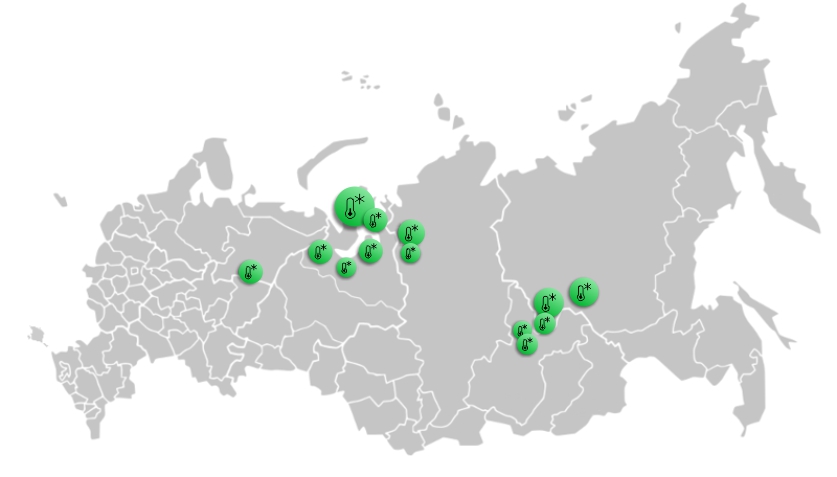
- More than 5 000 км2 have been explored (mainly in Western Siberia).
- More than 150,000 physical observations (23,000 linear km) of the sTEM have been completed.
Geography of work